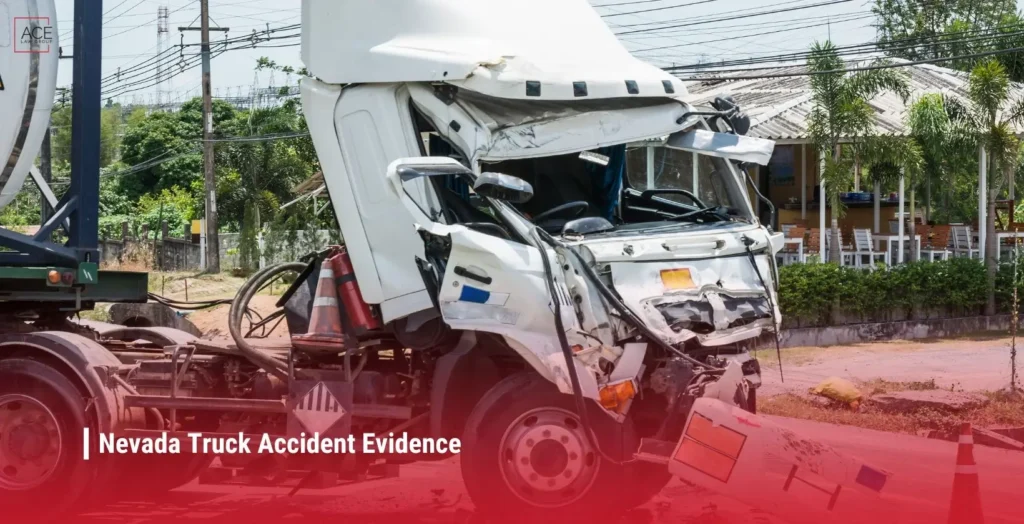
If you or someone you love was just hit by a commercial truck in Nevada, the first thing to understand is this: truck accident evidence disappears fast. Defense teams hired by large carriers often arrive at the crash scene while victims are still in the emergency room.
Truck accident cases are not built solely on police reports. Commercial trucks operate under Federal Motor Carrier Safety Administration (FMCSA) regulations that generate records most drivers never have to think about: electronic logging device (ELD) data, black box recordings, inspection reports, drug test results, and driver qualification files. Each one is a potential source of proof. But several of those records have short preservation windows, some as brief as seven days, before they are deleted or overwritten.
Knowing what truck accident evidence exists, who controls it, and how fast it disappears is often the difference between a strong truck accident claim and a dismissed one. At Ace Law Group, we move immediately to secure this evidence before it’s gone.
At a Glance: 9 Types of Evidence in a Nevada Truck Accident Case
| S.N | Evidence Type | Who Controls It | Preservation Window |
|---|---|---|---|
| 1 | Black Box (EDR) Data | Trucking company | 30 days before overwrite |
| 2 | ELD Records | Trucking company/carrier | 6 months (FMCSA minimum) |
| 3 | Driver Logbooks and HOS Records | Driver/carrier | 6 months |
| 4 | In-Cab and Dashcam Footage | Fleet operator | 7 to 30 days |
| 5 | Maintenance Records and Employment File | Trucking company | Duration of employment + 3 years |
| 6 | Fuel Receipts and Transaction Records | Third-party vendors | Varies |
| 7 | Cell Phone Records and Drug/Alcohol Tests | Carrier/telecom provider | Subpoena required |
| 8 | Police Report and Scene Documentation | Law enforcement/victim | Immediately collectible |
| 9 | Eyewitness Statements | Independent witnesses | Fades over time |
Why Truck Accident Cases Demand More Than a Police Report
A Las Vegas car accident investigation typically starts and ends with two drivers, one insurer, and a police report. But a truck accident investigation is a different process entirely.
Commercial trucks operate under a dense web of federal regulations. When a crash occurs, the carrier, its insurer, and often a third-party logistics company each have legal exposure, and they know it.
Nationally, FMCSA recorded approximately 503,000 police-reported large truck crashes in 2022, with more than 5,200 resulting in fatalities. Nevada’s commercial corridors, particularly Interstate 15, Interstate 11, US-93, and US-95, see a consistent share of that volume year over year. Behind each statistic is a case where evidence either survived long enough to support a claim or was lost before an attorney could act.
The police report captures the surface. What wins cases is what the carrier kept in its servers.
9 Types of Evidence That Build a Nevada Truck Accident Case
Not all truck accident evidence lasts the same amount of time. Black box data can be overwritten in as little as 30 days. Dashcam footage disappears in as few as seven. Witness memories fade within days of the crash.
1. Black Box (Event Data Recorder) Data
Most commercial trucks carry an Event Data Recorder, the trucking equivalent of an aircraft’s black box. In the seconds before impact, it captures:
In Nevada truck accident cases, EDR data is admissible when properly authenticated and obtained through the discovery process. It is among the most direct ways to establish what the truck was doing in the seconds before impact.
| Data Point | What It Reveals |
|---|---|
| Speed Before Impact | Confirms speeding, e.g., 68 mph in a 55 mph zone |
| Brake Application | Shows if the driver braked too late or not at all |
| Throttle Position | Indicates whether the driver attempted to slow down |
| Driving Hours | Supports fatigue or hours-of-service violation claims |
The critical problem is that this data is typically overwritten within 30 days. An attorney must issue a spoliation letter, a formal legal demand requiring the carrier to preserve all electronic records, within the first 24 to 48 hours after the crash. Nevada courts take it seriously, and carriers that destroy records after receiving that notice can face sanctions, adverse rulings, or both. Carriers sometimes argue that the black box data was corrupted during the crash or improperly extracted. An independent forensic download by a qualified technician is the standard that holds up against that challenge.
2. Electronic Logging Device (ELD) Records
Since the FMCSA’s electronic logging mandate took full effect in 2017, most commercial drivers are required to record their driving time on a certified ELD rather than a paper log. The ELD connects directly to the truck’s engine and records driving time automatically, removing the ability to falsify hours after the fact.
ELD data and paper logbooks serve as cross-checks. If the paper log shows a required rest period but the ELD recorded engine activity during that same window, that discrepancy is direct evidence of an hours-of-service violation. Attorneys subpoena both.
3. Driver Logbooks and Hours-of-Service Records
Federal hours-of-service rules limit how long a commercial driver can operate without mandatory rest. Common violations found in logbook audits include overdriving daily limits and deliberately falsifying rest entries.
Paper logbooks become most valuable when compared against ELD records and fuel receipts. If a driver logged a rest break outside Las Vegas but a timestamped fuel receipt places the truck at a Mesquite truck stop 90 minutes later, that contradiction points directly to hours-of-service non-compliance and potential fatigue at the wheel.
4. In-Cab and Dashcam Footage
Most commercial fleets running Nevada highways now carry dual-facing dashcam systems with AI monitoring built in. When properly preserved and authenticated, this footage is admissible evidence in a Nevada truck accident claim and directly counters conflicting driver accounts.
| Camera Type | What We Look For |
|---|---|
| Outward-Facing (The Road) | Speed, braking, lane position, and traffic signals in the moments before impact |
| Inward-Facing (The Driver) | Phone use, drowsiness, or hands-off-wheel events flagged by the truck’s onboard system |
Dashcam data is volatile. Many systems auto-delete recordings in as few as seven days. Securing the original file from the carrier’s cloud server, not a copy, is a first-day priority on the list of lawyer tasks. Footage without a verified chain of custody can be challenged as altered or incomplete.
5. Truck Maintenance Records and Driver Employment File
Under FMCSA §396.3, commercial carriers are required to conduct regular inspections and keep detailed maintenance records. When those records show overdue brake repairs, worn tires, or ignored steering alerts, liability can shift from the driver to the company that kept the truck on the road.
The driver’s employment file adds a second layer. It establishes whether the carrier properly vetted the driver before putting them behind the wheel. Expired licenses, undisclosed medical conditions, and prior disciplinary history in the employment file all support claims of negligent hiring or negligent supervision under Nevada law.
6. Fuel Receipts and Transaction Records
Timestamped receipts from gas stations, rest stops, and restaurants are third-party records that no one can retroactively alter. They place the driver at a specific location at a specific time.
For instance, if a driver logs a delivery arrival in Henderson but dispatch GPS records place the truck still on Interstate 15 thirty minutes later, that discrepancy goes beyond a clerical error. It points to fraudulent logging, and in Nevada truck accident cases, fraudulent logging can support a claim for punitive damages against the carrier, not just the driver.
7. Cell Phone Records and Drug/Alcohol Test Results
Phone records obtained through a subpoena can show whether a driver was texting or on a call at the moment of impact. A text sent two minutes before a collision is among the clearest forms of distracted driving evidence available.
Post-crash drug and alcohol testing is mandatory under FMCSA §382.303 when a crash results in injury, fatality, or a towed vehicle. Alcohol testing must occur within eight hours. Drug testing must occur within 32 hours.
Chain of custody documentation tracks who collected the sample, how it was stored, and who handled it at every step before testing. If that chain breaks at any point, the carrier’s defense team can argue the sample was contaminated or mishandled, which can get the results thrown out entirely. A positive test with a clean chain of custody can support claims for gross negligence and, in certain cases, punitive damages against the driver and the carrier.
8. Police Report and Scene Documentation
The police report is the foundation, not the ceiling, of a truck accident case. It records vehicle positions, driver statements, road conditions, witness names, and any citations issued. If it is incomplete or inaccurate, your attorney can challenge and supplement it during the claims process.
Scene documentation collected at the time of the crash adds critical context: photos or videos of the truck’s license plate and DOT number, skid marks, debris patterns, road conditions, and visible injuries. Photos should be timestamped and taken from multiple angles. Surveillance footage from nearby businesses should be requested before their systems overwrite.
9. Eyewitness Statements
Independent witnesses have no financial stake in the outcome of your case. That neutrality gives their accounts significant weight with insurers, mediators, and juries.
Eyewitnesses can confirm speed and braking patterns before impact, lane departures caused by distraction or fatigue, and whether the driver ran a red light or ignored a stop sign. Their recollections fade quickly. Collecting names and contact information at the scene, and following up within days, preserves this evidence before memory erodes.
How Fault Is Proven in a Nevada Truck Accident
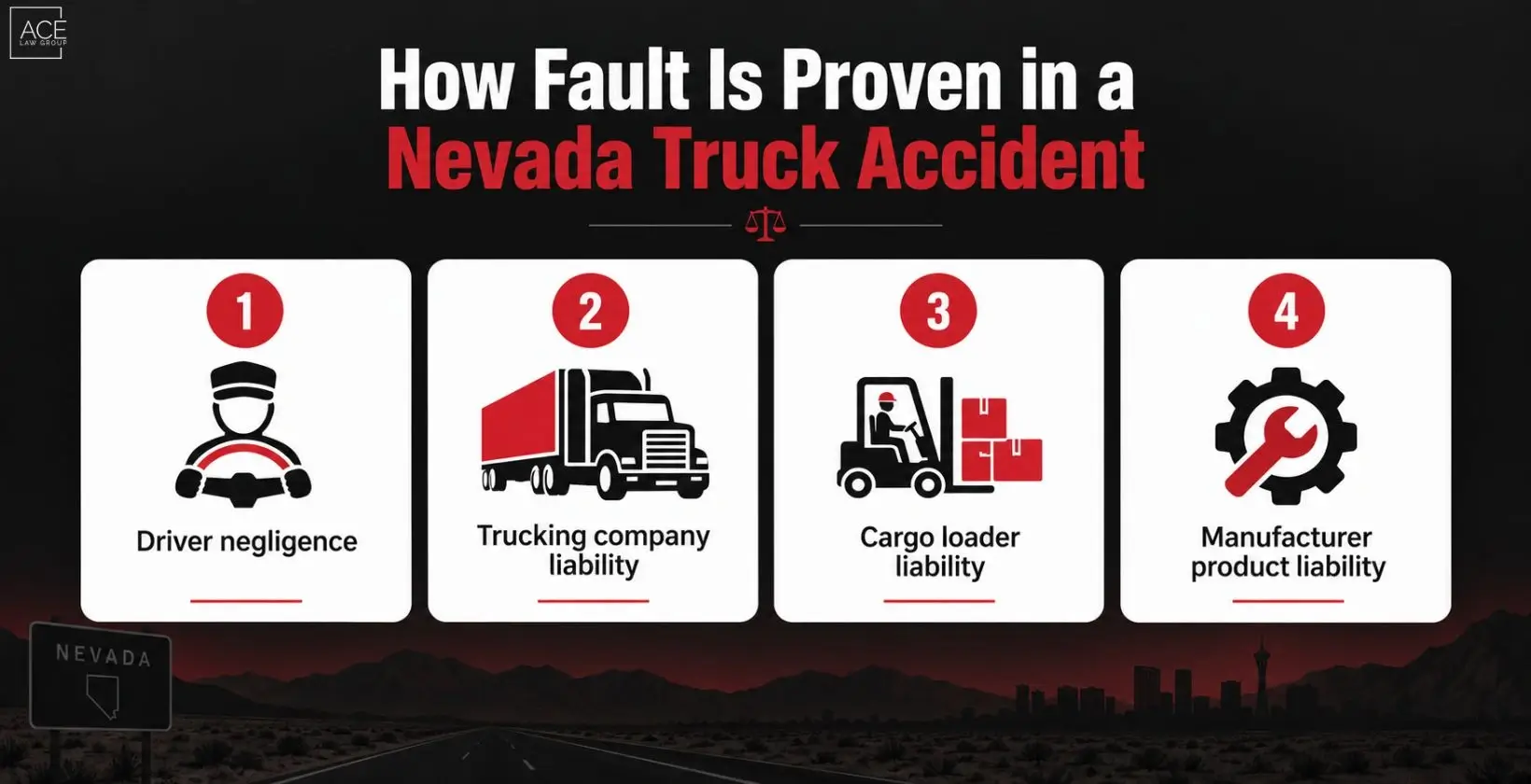
Liability in a truck crash rarely lands on one party. Nevada law allows injured victims to pursue all responsible parties, and identifying each one requires matching the right evidence to the right theory of negligence.
- Driver negligence is proven through the records tied to the driver’s own actions: EDR speed data, ELD and logbook records showing HOS violations, and post-crash toxicology results confirming impairment.
- Trucking company liability arises through vicarious liability when the driver was acting within the scope of employment, and through direct negligence theories, including negligent entrustment, negligent hiring, and failure to maintain the fleet. Fleet maintenance logs and employment files are the primary evidence.
- Cargo loader liability is often overlooked. When an improperly loaded or unsecured cargo load causes a truck to become unstable, the company responsible for loading may share or bear primary liability, independent of what the driver did.
- Manufacturer product liability applies when a mechanical failure, a defective brake component, or a faulty tire traces back to a design flaw, a manufacturing defect, or an unaddressed recall. Attorneys work with engineers to trace the failure chain.
Under Nevada NRS 41.141, the state follows a modified comparative fault rule. If you share fault for the crash, your compensation is reduced by your percentage of responsibility. At 51 percent or more at fault, recovery is barred. This makes the strength and completeness of your evidence directly tied to your financial outcome.
What Happens When a Trucking Company Destroys Evidence?
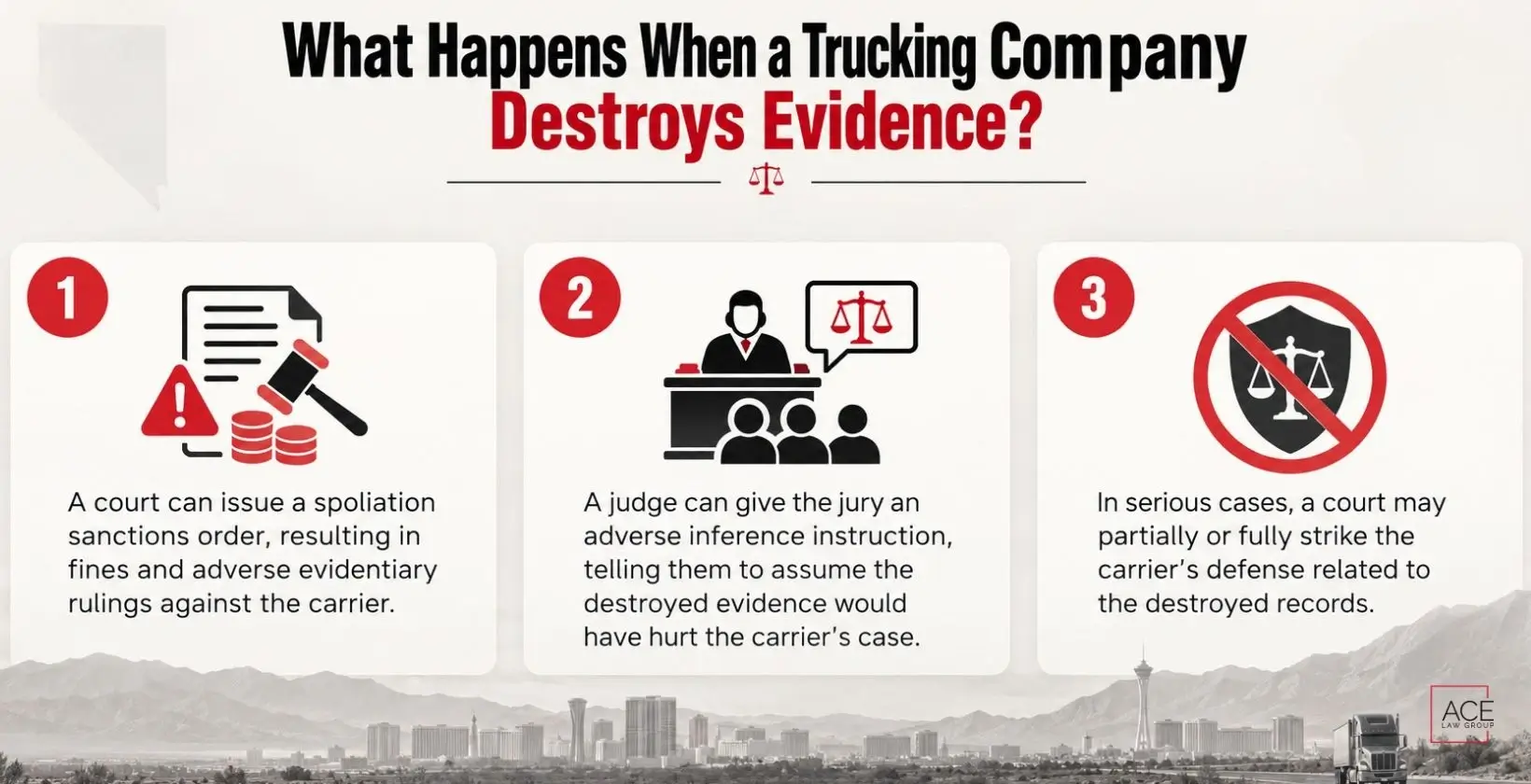
When a carrier fails to preserve evidence after a crash, Nevada civil procedure provides real consequences:
- A court can issue a spoliation sanctions order, resulting in fines and adverse evidentiary rulings against the carrier.
- A judge can give the jury an adverse inference instruction, telling them to assume the destroyed evidence would have hurt the carrier’s case.
- In serious cases, a court may partially or fully strike the carrier’s defense related to the destroyed records.
These are not minor procedural penalties. An adverse inference instruction alone can reshape the entire liability picture in front of a jury.
This is why your attorney, not you, needs to move on day one. Within the first 24 to 48 hours, an attorney should issue a formal spoliation notice, a legal demand requiring the carrier to preserve the black box, ELD records, and all telematics data. An independent investigator should be dispatched to the salvage yard before the truck is repaired or scrapped. Cloud-based GPS and ELD records need to be locked down before the standard seven-to-fourteen-day overwrite cycle runs out.
What to Do After a Truck Accident in Nevada
The first minutes and days after a truck crash determine what evidence survives.
- Document the scene immediately. Photograph the truck’s license plate, DOT number, company name, and all vehicle damage from multiple angles.
- Record road and environmental conditions. Skid marks, debris, traffic signals, lighting, and weather all become relevant.
- Collect witness information. Names and phone numbers from anyone who saw the crash.
- Check for surveillance cameras at nearby businesses and request footage before their systems overwrite. Most systems cycle within 24 to 72 hours.
- Get medical care the same day, even if you feel fine. Insurance adjusters look for any gap between the crash date and your first medical record. A delay of even a few days can be used to argue that your injuries were caused by something else entirely.
- Contact a truck accident attorney before speaking to the carrier’s insurer. Their adjuster’s job is to limit your settlement.
Nevada’s statute of limitations for personal injury claims is two years from the date of the crash under NRS 11.190. That deadline sounds distant. The evidence deadlines are not.
How a Truck Accident Lawyer Helps Strengthen Your Evidence
Here is what changes the moment an experienced truck crash lawyer is working on your claim.
- Subpoena Power: Trucking companies don’t volunteer their records. Under Nevada’s civil discovery rules, an attorney can compel the carrier to produce EDR data, ELD records, GPS logs, dispatch communications, and the driver’s full qualification file. Without a subpoena, most of that evidence stays locked.
- Crash Reconstruction and Expert Analysis: Independent crash reconstruction specialists rebuild the sequence of events using vehicle damage, skid marks, EDR data, and road geometry. In Clark County cases, these experts are routinely deposed and cross-examined, so the quality of the reconstruction matters as much as the data behind it. FMCSA compliance auditors review the carrier’s safety history separately, looking for patterns of regulatory violations beyond the crash itself.
- Full Liability Mapping: Under Nevada law, a truck accident victim can file claims against every party whose negligence contributed to the crash. When multiple parties share fault, multiple insurance policies may be available. An attorney identifies each responsible party and pursues each policy separately to maximize the compensation available to you.
- Case Protection: Social media posts, gaps in medical treatment, and missed insurer deadlines are the most common ways strong cases lose value. An attorney keeps your claim on track and counters the tactics adjusters use to reduce payouts.
When Should You Call a Truck Accident Attorney in Nevada?
The evidence timeline doesn’t pause while you recover. EDR data can be overwritten in 30 days. Dashcam footage can be gone in seven. Witness memories fade faster than either. The clock on your evidence starts the day of the crash, not the day you file.
The sooner you choose a qualified attorney to work on your case, the more of that evidence can be preserved. Call Ace Law Group at (702) 333-4223 for a free consultation, or complete our contact form, and we will reach out to you directly.